
Abolish HR
This entire fraud department exists to protect management from you, not to help you. I know because I was inside. Let me tell you what HR actually does.

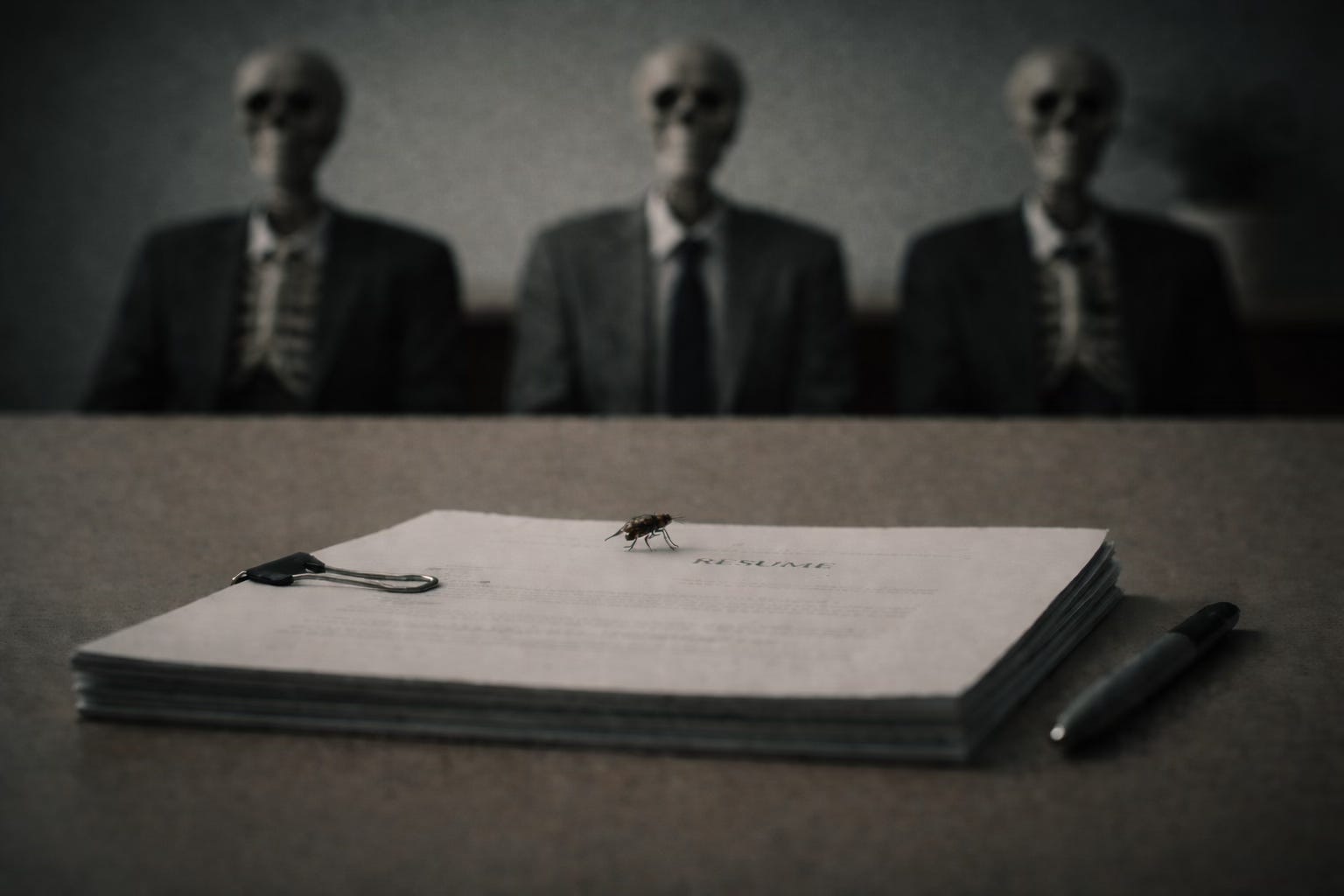
Open the portal. Upload the soul.
PDF format preferred. No larger than 2MB. Include a cover letter explaining why you deserve to exist.
The ritual begins. You adjust your CV for the seventeenth time this week. You remove personality. You add keywords. You become a search-optimized ghost, a human-shaped collection of “synergies” and “cross-functional collaboration” and other phrases that mean absolutely nothing but sound like they might unlock a door.
On the other side of that door sits someone from HR.
They will not understand your job. They will not understand the technology. They will not understand the actual work. But they will decide whether you get to eat next month.
I know this because I was that person once. Fresh out of university, business administration degree still warm, I stumbled into an HR department and stayed for a year. The most fraudulent, embarrassing twelve months of my entire life.
Confession-time!
Let me tell you what I actually did in HR.
I did not help people. I did not find talent. I did not “align human capital with organizational objectives” or whatever the brochure promised.
I lied.
Support my work with a tip. Some coffee money or a pack of cigarettes, perhaps. And follow me on X to experience more of my great personality.
I lied to candidates about company culture. I lied about growth opportunities. I lied about work-life balance while sending rejection emails at 11 PM because my manager liked seeing activity in the shared inbox. I told people they were “not the right fit” when I had no fucking idea what the right fit even looked like. I filtered CVs based on vibes, gut feelings, and whether someone’s photo reminded me of a person I once disliked.
HR doesn’t work for you, the applicant. HR doesn’t even work for the employees.
HR exists to protect management from legal liability.
That’s it. That’s the whole thing. Every wellness initiative, every “open door policy,” every carefully worded email about “supporting our team members during challenging times”—all of it is liability management dressed in human language.
When I raised concerns about actual employee wellbeing, I was told to document everything in ways that protected the company. When I suggested we actually respond to candidates instead of ghosting them, I was told we didn’t have “bandwidth.” When I pointed out that our job descriptions were written by people who had never done the job, I was told that was “not my area.”
My area, apparently, was pretending to care with professional efficiency.
The kingdom of incompetence
Here’s the thing nobody says out loud:
HR has no idea what they’re hiring for.
When a software team needs a developer who understands distributed systems, HR filters for “5+ years of experience” and “team player” because those are the words they recognize. They cannot tell the difference between a brilliant engineer and a mediocre one. They cannot assess technical skill. They cannot evaluate problem-solving ability. They can only count keywords and check boxes.
I once watched a colleague reject a candidate because their resume was “too technical.” Too technical for a technical role. The hiring manager never even saw that application!
We gatekept positions we did not understand. We assessed skills we could not verify. We made decisions about people’s lives based on criteria we invented in meetings where no one who did the actual work was present.
And the truly demonic part? Most of what HR does is actively detrimental to finding good people.
We created job postings asking for five years of experience in technologies that have existed for two. We demanded cover letters that no one reads. We used personality assessments that had roughly the same predictive validity as astrology. We scheduled four rounds of interviews because more process felt like more rigor, even though it just exhausted everyone and selected for people who are unemployed enough to attend.
The system isn’t broken. The system is the break.
The robot uprising, but boring
Now here’s where it gets interesting.
AI has entered the chat.
And HR, in its infinite wisdom, responded by deploying automated screening systems that reject candidates at rates that would make a human blush. The machines learned from biases, then scaled them to industrial efficiency. Studies show that AI hiring tools systematically discriminate against women, minorities, and anyone whose resume doesn’t match the training data (which is, of course, the resumes of people who were already hired by humans with biases).
So what did the candidates do?
They started using AI to apply.
Of course they did.
If your application will be read by a robot that scans for keywords, why wouldn’t you use a robot to generate those keywords? If the system treats you like data, become data. Optimize yourself into a perfect match. Let the machines talk to each other while humans nervously wait to find out if they’ve been selected.
We’ve created an arms race. ATS systems filter thousands of applications. AI tools generate thousands of tailored resumes. Algorithms match with algorithms. Humans have become the awkward middlemen in a conversation between bots, occasionally summoned to pretend that “culture fit” means something.
This is peak bullshit-capitalism: automating the lying.
The case for robot overlords
But here’s the twist. Here’s what the HR industry doesn’t want to admit:
AI could actually be better at this.
Not the current AI. Not the badly implemented, bias-amplifying, reject-everyone-who-doesn’t-use-the-right-font garbage we have now. But properly designed systems with proper oversight could be radically more fair than Karen from recruiting who subconsciously favors people who went to her alma mater.
A well-designed AI doesn’t get tired at 4 PM and starts skimming resumes. It doesn’t prefer candidates who share its hobbies. It doesn’t have an alma mater. It doesn’t unconsciously penalize employment gaps caused by caregiving or illness. It doesn’t feel threatened by people who seem too smart.
More importantly: an AI system can actually learn what predicts success in a role. It can analyze the actual performance of people who were hired, correlate it with their backgrounds, and adjust its criteria. HR has been “trusting their gut” for decades while their gut consistently chooses people who look like people who were already there.
The problem isn’t AI in hiring. The problem is that we automated the wrong thing.
We automated the gatekeeping instead of automating the bullshit away.
Imagine a system that:
Actually understands what the job requires (by analyzing what successful employees actually do)
Evaluates candidates on relevant skills rather than proxy signals
Provides feedback to every applicant instead of the void of ghosting
Removes human bias from the screening process while keeping humans in the final decision
Doesn’t require a cover letter explaining why you’re “passionate” about data entry
This is technically possible. But it would require HR to admit they don’t know what they’re doing. And that admission threatens too many salaries.
The abolition
HR needs to go.
Not reformed. Not “reimagined.” Not “transformed through digital innovation.”
Abolished.
Let the people who actually do the work choose their teammates. Let technical hiring be done by technical people. Let AI handle the screening—but properly, transparently, with audits and accountability instead of black-box discrimination.
Most importantly: decouple hiring from the performance theater of professionalism. Stop demanding that candidates pretend they’re “excited about this opportunity” when they’re scared of not paying rent. Stop requiring cover letters that nobody reads. Stop the six-round interview gauntlets designed to make companies feel rigorous while extracting free labor from desperate applicants.
The HR industrial complex has convinced us that hiring must be painful, opaque, and arbitrary. That ghosting candidates is acceptable. That treating job seekers like supplicants is just “how it works.”
It doesn’t have to work this way.
David Graeber noted that bullshit jobs proliferate when there’s a class of people whose job is to manage other people rather than do actual work. HR is the platonic ideal of this: an entire department dedicated to managing the management of humans, all while understanding nothing about the actual work those humans will do.
The current arms race—AI recruiters versus AI applicants, algorithms screening algorithms, humans reduced to nervous observers—is just the absurdity reaching its logical conclusion.
Let it collapse. Let the machines talk to each other. And while they’re busy, let’s build something that actually works.
The severance package
I left HR after a year. I couldn’t do it anymore.
Not because I was bad at it. I was fine at it. That was the horror. You learn to be fine at lying. You learn to be fine at rejecting people without explaining why. You learn to be fine at “managing expectations,” which means teaching people to expect nothing.
But every day I felt like a cop at a checkpoint, asking for papers I didn’t understand, in service of a border I couldn’t justify.
The candidates I rejected were probably fine. The ones I approved were probably fine. The difference between them was noise, not signal. I was paid to pretend the noise was wisdom.
Here’s my severance package for the HR industry:
Leave. Find real work. Work that produces something someone actually needs. Work where you can look at your output and say: this exists because of me, and it matters.
Or stay and become the thing you pretend to fight against: a machine that processes humans into outcomes, neither caring nor knowing why.
The irony of HR is that it’s inhuman.
Maybe let the robots do it. At least they don’t pretend to have feelings.
Thank you reading and thinking.
Antonio Melonio
Before you disappear into the void,
support my work, perhaps?
If you value independent, free, critical, and personal thoughts, please support writers such as me financially. It’s the only way to make sure the world doesn’t drown in curated bullshit.
And yes, I know. I know. I KNOW. Everyone hates subscriptions. I understand. That’s why you can support my work with a one-time tip (it’s like two clicks). No commitments there.
Even better (for me): you can, of course, also support me with a monthly subscription here on Substack:
I watched a girl get fired from her first month on the job, after leaving a different company which paid her well, to work for the one she was hired at under the guise of career growth. After speaking to the IT guy who was close with the hr director, he revealed a conversation to me. He said, “I told her[hr director] why are you ruining this girl? She has a good job, a good life, you know what kind of place this is…” to which she just shrugged it off and went on with her life. Turned out she had already been offered a better hr position at another company and this was just her last few days on the job. She didn’t care about the girl, her life, or wellbeing. She had already moved on. If humans governing humans has turned so inhumane, then why must hr remain human and not ai? I agree with your work.
I was sitting in a room full of job seekers in a “work (finding) workshop” when I got the notification with your title. I chuckled. I was told just two minutes before that I put too much of my personality into my CV. I do not want to work for anybody who can’t even bear my personality on a piece of paper.